
Training Programs
Most salespeople—regardless of experience—tend to struggle with a few common pain points that affect their performance, consistency, and confidence. Here’s a breakdown of the most frequent challenges:
Please email me on enquiries@topachieverssalestraining.co.nz if you would be interested in doing online training which is self regulated and comes with a workbook.
1. Lead Generation & Prospecting
The 70/20/10 Rule of Prospecting
This is a simple framework for dividing your sales prospecting activities to maximize results:
70% – Core, high-probability prospects
Focus your main effort on leads who are most likely to convert.
These are your warm leads, past clients, referrals, or target accounts with clear fit.
Why it works: You’re prioritizing where your energy produces the highest ROI.
20% – New, emerging opportunities
These are “stretch” prospects — people who may not know you yet but could become valuable clients.
Includes networking contacts, social media connections, cold outreach to qualified leads.
Why it works: Keeps your pipeline fresh and growing beyond your immediate circle.
10% – Experimentation & high-risk, high-reward prospects
Try new methods, industries, or untested campaigns.
Could include innovative social selling, niche markets, or unconventional outreach methods.
Why it works: Keeps you ahead of the competition and allows big wins with minimal resource investment.
Why This Works
Focus and efficiency: You spend most of your time where success is most likely.
Pipeline diversity: You’re not over-relying on one type of prospect.
Risk management: High-reward experiments are limited, so failure doesn’t derail your results.
Consistency: You maintain a constant flow of leads, avoiding boom-and-bust cycles.
How to Make It Work for You
Segment your prospects: Label your leads into 70/20/10 categories. Know who fits where.
Set daily/weekly targets: Allocate time based on the rule — e.g., if you spend 5 hours prospecting, 3.5 hours on 70%, 1 hour on 20%, 0.5 hours on 10%.
Track results: Measure conversion rates for each category. Adjust time allocation if needed.
Automate where possible: CRM systems, email sequences, and LinkedIn outreach can help scale the 20% and 10% activities.
Review & adapt: Each week, evaluate what’s working, what’s underperforming, and refine your strategy.
💡 Pro Tip: The 70/20/10 rule isn’t just about time—it’s about value and risk. Focus most energy where the chance of closing is high, invest in future opportunities, and play a little to win big.
Pain: Inconsistent or poor-quality leads.
Why: Lack of a repeatable system, unclear ideal customer profile (ICP), or not enough time spent prospecting.
Impact: Leads to dry pipelines and feast-or-famine sales cycles.

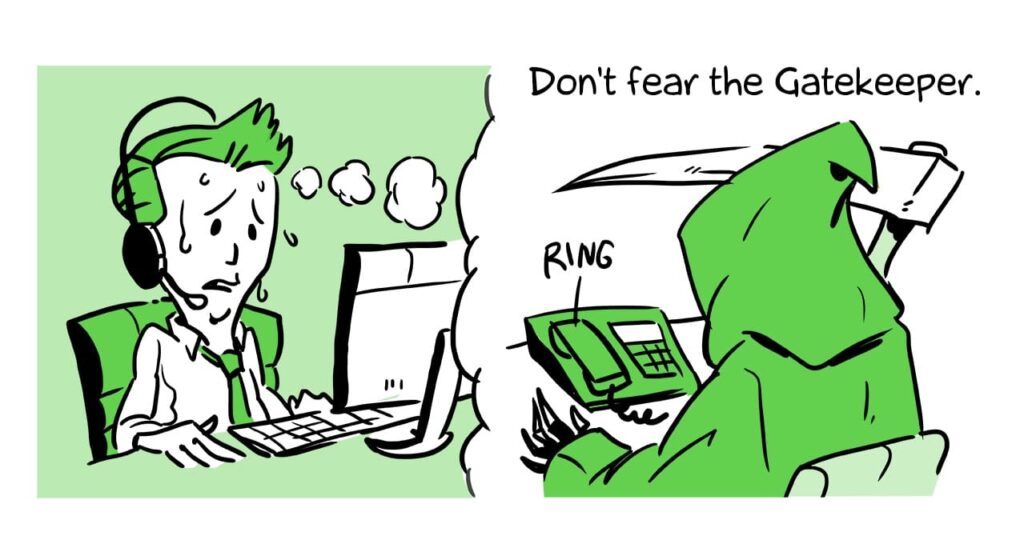
2. Getting Past Gatekeepers
Pain: Difficulty reaching decision-makers.
Why: Poor messaging or lack of strategy to get noticed and get through.
Impact: Wasted time and missed opportunities.
3. Qualifying Effectively
Pain: Chasing the wrong prospects.
Why: Not asking the right questions early or being afraid to disqualify.
Impact: Bloated pipelines, wasted effort, and lower close rates.

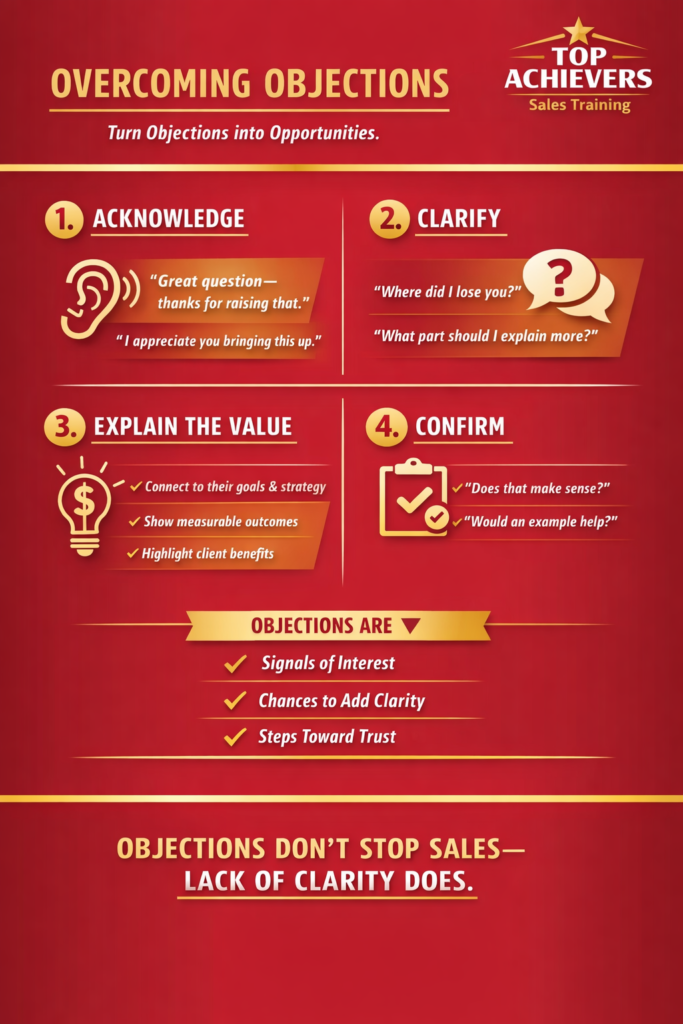
4. Handling Objections
Sales Objections Aren’t Pushback.
They’re Permission.One of the biggest misunderstandings in sales is thinking an objection means “no.”
It doesn’t.An objection usually means your client is saying:
👉 “Tell me more.”
👉 “I don’t have enough clarity yet.”
👉 “Help me understand this well enough to take it to senior leadership or the board.”
👉 “Show me how this aligns with our strategy and outcomes.”That’s not resistance.
That’s engagement.High-performing sales professionals don’t fear objections — they welcome them.
Because objections highlight exactly where clarity is missing, not where value is lacking.When a client raises an objection, it’s an invitation to:
• Explain your value proposition more clearly
• Connect your solution to business strategy
• Demonstrate outcomes and impact
• Build trust through transparencyThe worst thing in a sales conversation isn’t objections.
It’s silence.No objections often mean no real thinking, no ownership, and no momentum.
So instead of defending, reacting, or feeling uncomfortable — get curious.
Ask where you lost them.
Clarify what matters most.
Explain with confidence.Objections don’t stop deals.
Lack of clarity does.Pain: Feeling unprepared or reactive.
Why: Lack of training, confidence, or understanding of customer concerns.
Impact: Deals stall or die after pushback.
5. Closing Sales Consistently
1. Confirm Understanding
Before moving to a close, show that you truly understand the client’s situation:
Paraphrase: “So what I hear is that your main concern is improving [specific challenge], and you’re looking for a solution that can [desired outcome].”
Validate: “Does that sound right?”
This immediately reassures the client that you’re listening and not just selling.
2. Highlight the Solution
Connect your offering directly to their challenges:
Focus on benefits over features.
Keep it specific: “Based on what you’ve shared, our approach will [solve X problem] by [how it works], which means you can [desired result].”
3. Invite Collaboration
Instead of pushing, invite them to take action:
“Does this approach make sense for your team?”
“Would you like me to outline the next steps so we can get started?”
This makes the close feel like a natural conclusion to the conversation rather than a sales pitch.
4. Use Gentle Assumptive Closes
Assume they’re on board while still giving them space:
“Once we implement this, we can review results in [timeframe] to ensure it’s meeting your goals.”
“Which day works best for our first session to get started?”
5. Listen for Signals
Even if they don’t verbally say yes, look for buying signals:
Questions about implementation, ROI, or next steps.
Statements like “That would be useful for us.”
Respond by reinforcing solutions and confirming alignment.
6. Recap & Reinforce Value
End with a concise recap of benefits:
“To summarize, this approach addresses [key challenges], helps [desired outcome], and fits within [timeline/budget].”
This leaves the client confident in their decision and reduces buyer hesitation.
💡 Pro Tip: The key is empathy, clarity, and framing the close as a solution discussion, not a sales pitch. You become the guide, not the persuader.

6. Time Management
1. Set Clear Priorities
Focus on the platforms where your audience is most active.
Prioritize high-impact activities like engaging with leads and creating relevant content.
2. Batch and Automate Tasks
Batching: Dedicate specific time blocks for tasks like content creation, scheduling, and responding to comments or messages.
Automation: Use tools like Hootsuite, Buffer, or native scheduling features to plan posts in advance.
3. Use Templates and Repurpose Content
Create a library of reusable templates for posts, messages, and visuals.
Repurpose successful content across platforms (e.g., turn a blog into bite-sized social posts).
4. Leverage Analytics
Regularly review data to see what’s working and stop wasting time on activities that don’t generate results.
5. Make Social Media a Daily Habit
Spend 15–20 minutes a day engaging with your audience, which builds relationships without overwhelming your schedule.
Would you like me to expand on any of these ideas or tailor them more for your training script?
You’re absolutely right—time management and planning are foundational to success in both sales and life. Incorporating this into your training can inspire participants to develop habits that increase productivity and efficiency. Here’s how you can frame this principle in your script:
Time Management: The Foundation of Success
“Time is the one resource we can’t create more of. But we can manage it effectively to achieve our goals.”
Plan with Purpose
Start each day with a clear plan. Identify the three most important tasks you need to accomplish to move closer to your goals.
Use a planner or digital tool to schedule time for prospecting, follow-ups, and content creation.
The Power of Time Blocking
Dedicate specific blocks of time to key activities like lead generation, social media engagement, and customer meetings.
Protect these blocks as if they were appointments with your best client.
Work Smarter, Not Harder
Use tools to streamline repetitive tasks. Automation tools, CRM systems, and scheduling apps can save hours each week.
Focus on high-value activities that directly impact your sales pipeline.
Prioritize Self-Care
Remember, you can’t pour from an empty cup. Rest, exercise, and personal time are critical for maintaining energy and focus.
A healthy work-life balance isn’t just good for life—it’s also good for business.
Evaluate and Adjust
At the end of each day or week, reflect on what worked well and where you lost time. Continuous improvement is the key to long-term success.
Inspiration to Motivate Your Audience
“Success is not about having more time—it’s about making the most of the time you have. When you manage your time effectively, you’re not just more productive—you’re more present, focused, and in control.”

7. Differentiating from Competitors
Pain: Struggling to articulate unique value.
Why: Commoditized pitch or unclear positioning.
Impact: Competing only on price, which reduces margins.

8. Lack of a Clear Sales Process
Pain: “Winging it” instead of following a proven path.
Why: No structured sales playbook or coaching.
Impact: Inconsistent results and poor forecasting.

9. Confidence and Mindset Issues
Pain: Fear of rejection or imposter syndrome.
Why: Lack of support, training, or experience.
Impact: Hesitation, poor activity levels, burnout.

10. Adapting to New Tech (e.g., AI, CRM, social selling)
Pain: Feeling overwhelmed or behind.
Why: Poor training or resistance to change.
Impact: Inefficiency and missed modern sales opportunities.

Sales Training CEO of the Year (New Zealand) by APAC Insider
Leadership training to equip you to coach, train, inspire and motivate your teams to reach KPI’s, targets and budgets and fulfill the business strategy.
Psychological wellness training to equip yourself as a business owner or your team leaders to identify and help your team members with coping strategies to address psychological wellness issues.
High Performing teams are how organisations increase their success. Leaders need to know how to get their teams to perform consistently, have an open and trusting relationship, have constructive conflict, commit to themselves, the company, and their clients, and support and challenge each other to deliver individual and team commitments and be result fanatics.
Courses that focus too much on theory and not enough on “boots-on-the-ground” takeaways can leave employees enlightened, but with nowhere to go. A high-impact training experience couples a theory with practice and offers real-world next steps for students.
“Leading the Charge: Mastering Sales Leadership for Success”
Sales and leadership training course
Participants will be able to apply effective negotiation techniques to close deals successfully.
Participants will demonstrate improved communication skills for building rapport with clients and team members.
Participants will create a personalized sales strategy that aligns with their leadership style.
Participants will understand and practice ethical selling practices for long-term customer relationships.
Participants will exhibit enhanced leadership qualities through team-building exercises and role-playing scenarios.
Having clarity around your value proposition, cold calling and prospecting tips and processes, account and territory management, overcoming objections with clarity, and professionalism
What do people want to achieve from sales training?
Improved Sales Skills: Participants often aim to enhance their sales skills, including prospecting, lead generation, objection handling, and closing techniques.
Increased Confidence: Many seek to boost their confidence in selling, enabling them to approach potential clients with assurance and conviction.
Enhanced Communication: Effective communication is crucial in sales. Participants want to improve their ability to articulate value propositions, listen actively, and build rapport.
Negotiation Mastery: Negotiation skills are vital for closing deals on favorable terms. Participants want to learn strategies to negotiate win-win outcomes.
Better Product Knowledge: A deep understanding of the products or services being sold is essential. Sales training can help participants become product experts.
Time Management: Sales professionals often have to balance multiple tasks. Learning time management strategies help you to prioritize activities that drive results.
Closing Techniques: Participants often seek specific techniques for confidently asking for the sale and overcoming objections at the critical closing stage.
Customer Relationship Building: Building long-term relationships with clients is crucial. Sales training can provide insights into nurturing customer relationships.
Adapting to New Trends: Using AI in your sales process for increased success.
Goal Achievement: Salespeople often have quotas or targets. Training can help them strategize and work efficiently to achieve their sales goals.
Team Collaboration: Sales training might involve team-based activities to improve collaboration among sales team members.
Understanding Buyer Psychology: Participants often want insights into understanding buyer behavior and psychology to tailor their approaches effectively.
Handling Rejection: Dealing with rejection is a common challenge in sales. Training can equip participants with coping strategies and a resilient mindset.
Leadership Development: Sales managers may seek training to improve their leadership skills and manage their teams more effectively.
Consistency and Sustainability: Participants aim to create consistent sales performance over time and develop sustainable sales practices.
By addressing these objectives in sales training, you can provide participants with valuable skills and knowledge to excel in their sales roles.
Contact us today to make a plan tailored for you and your team!
Your business relies on you understanding your value, and a solid sales process, which includes prospecting, communication, account, and territory management, closing sales, following up leads, new business development, increasing profitability, through meeting targets, and budgets?
Are you new to sales? Been in sales but struggling with getting the sales, or closing or understanding your value proposition, what makes you different to your competition? Do you have a great sales process but have difficulty closing?
Are you simply overwhelmed with time management in sales and leadership? Are you a Sales Manager who is expected to look after your team as well as managing your own territory or accounts?
I would love to help you and your team to focus on what is needed to achieve your goals, targets and budgets.
The Training is tailored to you, your team, your business, and your industry. Training can be conducted online or in person. Let me know what would work for you and your team. We cater to one on one training or small group training.
The training covers mindset mastery behind the psychology and neuroscience of sales.
Sales Leadership covers tips and the psychology of running a well-oiled team.
Telemarketing is the science behind cold calling and how important this is to your entire sales process.
Customer Service – more than ever before having a well-trained customer service team is what is going to set you apart from the opposition and grow the profitability of your company.
My training is tailored to provide you, or your business with the market best of sales training and development. Tailoring business strategies to meet and exceed KPIs, budgets, and a whole array of other services. Bringing simplicity to complexity, and helping deliver your best you to your customer base.
Our Upcoming Education Events
-
Wellington
Corporate Sales Training – Christchurch Full Day
$1,200.00 – $14,925.00Price range: $1,200.00 through $14,925.00 Add to cart This product has multiple variants. The options may be chosen on the product page -
Christchurch
90 Day Fast Track 1 to 1 Sales Training – Christchurch in Person
$1,800.00 Add to cart This product has multiple variants. The options may be chosen on the product page


